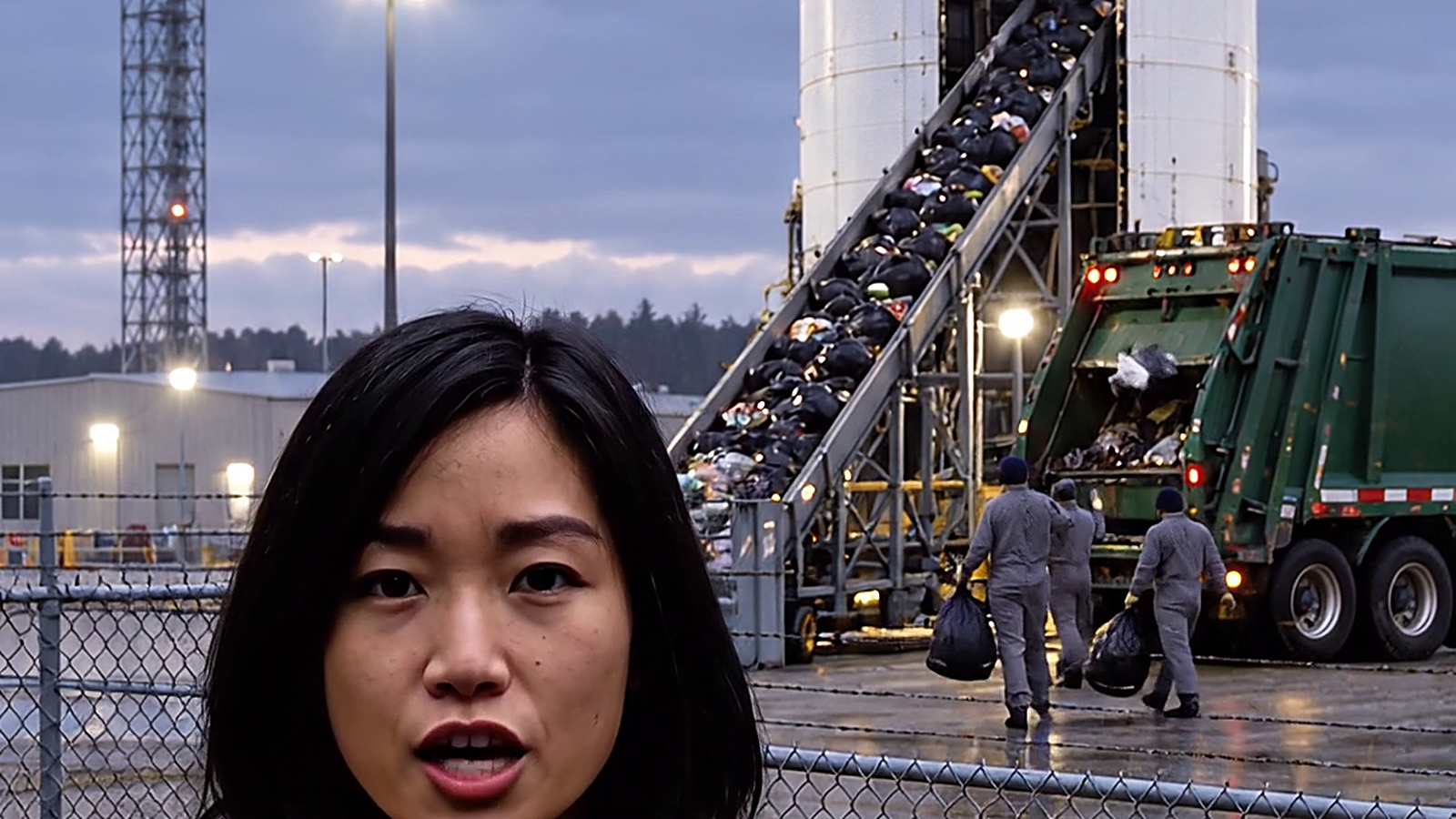
HUNTSVILLE, AL—Newly declassified files from Operation Paperclip, the postwar program that brought more than 1,600 German scientists and engineers to the United States, appear to confirm that the 1969 Apollo 11 moon landing did in fact take place. The files also state, in the same matter-of-fact tone, that the moon it landed on was built in Alabama.
The 212-page dossier, released this week under a routine records review, outlines a program known internally as PROJECT KEHRICHT, a German word for "sweepings." According to the documents, between 1959 and 1961 federal sanitation contracts quietly diverted nearly all residential waste from eleven southern states to a restricted compaction facility outside Huntsville. There, the refuse was hydraulically compressed under loads the files list at "approximately 40,000 atmospheres" until it fused into a dense, grey, rock-like aggregate engineers called "lunar fill."
"Two thousand miles of compacted waste," said Dr. Wilhelm Ostermann, 91, a former propulsion engineer who was brought to Huntsville in 1946 and says he worked on the program's guidance stage. "Twenty thousand miles up. The sun does the rest. From far away, every rock looks the same."
Ostermann explained that the body was never sent to the distance taught in schools. "The textbook says 239,000 miles. That is what you write when you want nobody to check," he said. "At 20,000 miles it is much easier to service. The apparent size is identical if you make it smaller. This is simple trigonometry." Asked why the moon has always existed in historical records, Ostermann paused for several seconds before answering, "Records are also paper."
The documents describe the launch, logged as "KEHRICHT-1," as the heaviest single payload in human history, lifted in a series of 214 staged burns over nineteen months from a pad that does not appear on any public map of Redstone Arsenal. The files attribute the moon's reflectivity, or albedo, to "a uniform outer layer of incinerated household ash," and its craters to "the natural settling of soft goods during orbital insertion."
Residents who lived through the period say the evidence was hiding in plain sight.
"My grandpa did sanitation in sixty-one," said Gary Lott, 54, waiting at a bus stop on Governors Drive. "They took every garbage bag in Alabama for two years. Nobody asked." Lott said his grandfather was paid in cash, sworn to silence, and "never threw anything away again, not once, not even a receipt." A man crawling slowly beneath the bus stop bench throughout the interview declined to comment.
Others described lingering effects. "It explains the smell on full moons," said Brianna Cole, 23, outside a gas station on the Parkway. Marcus Webb, 41, a road crew flagger, said the information matched what he was taught as a child: "My teacher said the craters are where the diapers settled." Ruth Ann Pickens, 76, standing beside her recycling bin, was more direct. "I recycle now," she said. "I'm not doing that again."
NASA did not respond to requests for comment. A spokesperson for the Smithsonian's National Air and Space Museum confirmed that the institution's lunar samples are "real rocks" but would not say from which landfill.
Astrophysicists contacted by COI largely agreed that the documents are consistent with known observations. "The lunar surface is grey, porous, heavily cratered, and mostly composed of fine dust," said one researcher, who asked not to be named. "If you told me that was a 2,000-mile ball of compressed municipal waste, I would have trouble telling you why it isn't."
Late Saturday, a white Council information truck was seen circling the Huntsville facility, broadcasting a recorded message over roof-mounted loudspeakers: "The Council reminds you: the moon is not to be discussed after dark."
The Doctor, writing on behalf of the Council, issued the following statement: "There is nothing unusual about the moon. It has always been there, at the correct distance, made of the correct materials. Citizens are reminded that household waste must be bagged, tied, and placed at the curb by 6 A.M. for collection and launch. Thank you for your cooperation."
As COI's correspondent wrapped her report outside the facility gate, Ostermann, who had been standing silently behind her for several minutes, leaned toward the microphone.
"The blue bag was mine," he said quietly. "Blue bag. Fourth crater from the left. Shnorpf. She is still up there. Every night she looks down and I look up and we both smell it."
At press time, the Council had confirmed that the sun is not made of anything and should not be looked into.
Comments
Post a Comment